- Home
- Minimally Invasive Brain Surgery
Minimally Invasive Brain Surgery in bhopal
Smaller openings, precise planning and faster recovery wherever it is safe
Overview
Brain surgery is a phrase that frightens almost everyone. Families worry about long hospital stays, big scars and a slow recovery. The good news is that modern neurosurgery has changed. With advanced imaging, microscopes and endoscopes, many conditions can now be treated through smaller openings and with less disturbance to healthy tissue. Dr. Harshad Patil, an M.Ch-qualified neurosurgeon, offers Minimally Invasive Brain Surgery in Bhopal for suitable patients, with careful planning, honest advice and close follow-up. Patients today search for a Minimally Invasive Neurosurgeon in Bhopal who can explain whether a smaller approach is right for their condition, and for the Best Neurosurgeon in Bhopal who will put their safety before everything else. This page explains how minimally invasive techniques work, which conditions they can treat, how to choose a surgeon, and what recovery looks like.
Brain Tumor & Brain Surgery
Discuss this with the clinic
Consult our experienced neurosurgeon to learn about brain tumor diagnosis, treatment options, and surgical care tailored to your needs
Why Choose Dr. Harshad Patil for Minimally Invasive Brain Surgery in Bhopal?
Choosing a neurosurgeon is a big decision. Here is what patients and families value most about our clinic:
- Super-specialist training: M.Ch in Neurosurgery (2013–2016) from Sri Aurobindo Medical College and PG Institute, Indore, after M.S. in General Surgery and MBBS.
- Experience in Bhopal: Practising in Bhopal as a Consultant Neurosurgeon since July 2017, after working as Registrar and Assistant Professor in Mumbai and Navi Mumbai.
- Tumor and brain-injury experience: Patients look for a Brain Tumor Specialist in Bhopal who understands both tumors and trauma, and Dr. Patil’s clinical and research work covers posterior fossa tumors, adult medulloblastoma, traumatic brain injury and intracranial hemorrhage.
- Case-by-case planning: Anyone seeking a Minimally Invasive Brain Surgeon in Bhopal should know that the right approach depends on the condition. We recommend a smaller approach only when it is safe and effective for you.
- Research-backed practice: 25 published papers and case reports, including articles in World Neurosurgery and Neurology India.
- Active in the professional community: Organiser of the ISNOCON 2019 (Indian Society of Neuro-Oncology) Annual Conference and Workshop, Bhopal.
- Clear communication: We explain the diagnosis, the plan, the risks and the alternatives so your family can decide with confidence.
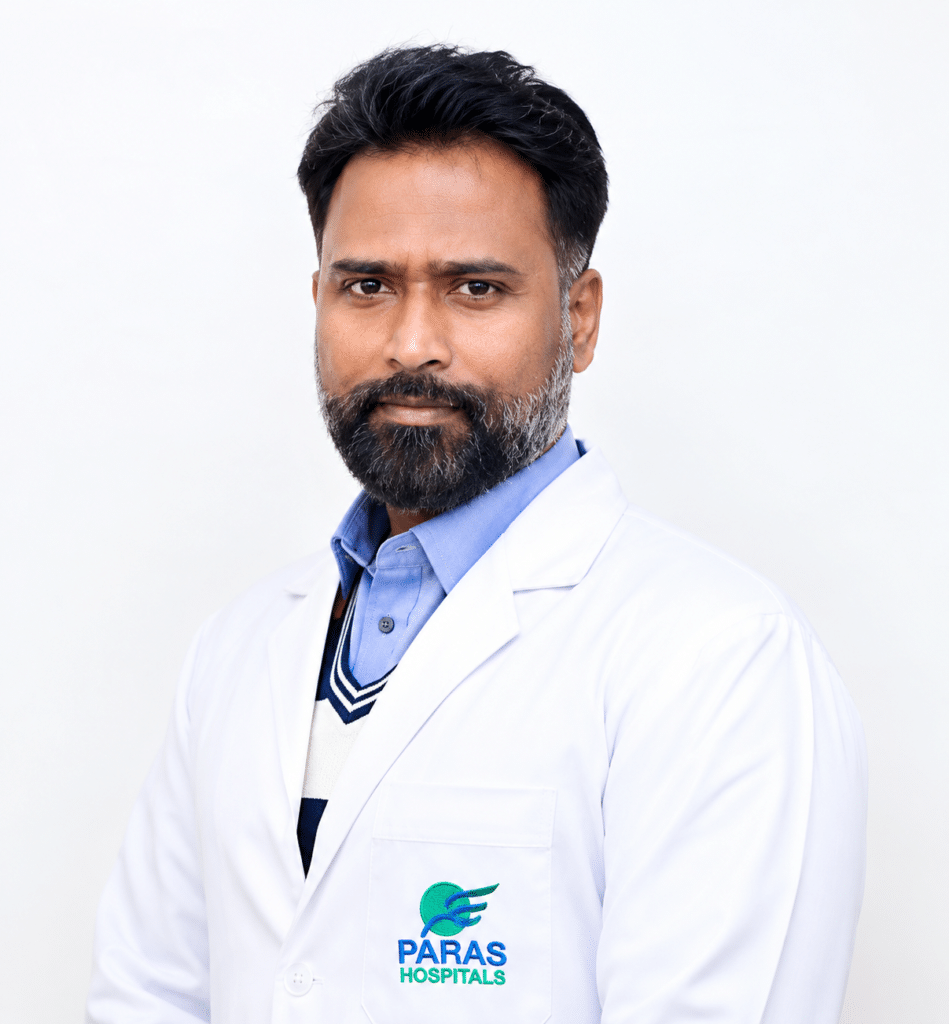
Meet Your Neurosurgeon: Dr. Harshad Patil
Dr. Harshad Patil is a Consultant Neurosurgeon who has dedicated his career to disorders of the brain, spine and nervous system. After completing MBBS at Terna Medical College, Navi Mumbai, he earned his M.S. in General Surgery from Dr. Vasantrao Pawar Medical College, Nashik, and then trained in M.Ch Neurosurgery at Sri Aurobindo Medical College and PG Institute, Indore. He later worked as Registrar in Neurosurgery at Dr. R. N. Cooper Hospital, Mumbai, before joining Bansal Hospital in Bhopal.
His academic work includes studies on severe traumatic brain injury and brain-swelling management, along with reports on adult medulloblastoma, posterior fossa teratoma in a child, spinal schwannomatosis and intraspinal tumors. This exposure to a wide range of tumors shapes the way each surgery is planned. For anyone searching for a Brain Tumor Specialist Doctor in Bhopal, this blend of surgical training, academic involvement and everyday clinical practice offers real reassurance. Dr. Harshad Patil works from a well-established Neurosurgery Hospital in Bhopal, where diagnosis, surgery and recovery care are managed together.
What Is a Minimally Invasive Brain Surgery in Bhopal?
Minimally invasive brain surgery means treating a problem inside the skull through the smallest opening that still allows the surgeon to work safely. Instead of a large exposure, the surgeon plans a precise path to the target using MRI and CT scans, then uses a surgical microscope, a thin endoscope or fine instruments to reach it while disturbing as little healthy brain as possible.
It is important to understand that “minimally invasive” describes the approach, not the seriousness of the problem. The goals of surgery remain the same as in open surgery: to relieve pressure, treat or remove the disease, and protect function.
Benefits of Minimally Invasive Brain Surgery in Bhopal
When the technique is suitable for the condition, patients may benefit from:
- A smaller incision and a smaller opening in the skull
- Less disturbance of healthy brain tissue
- Less blood loss in many cases
- Reduced pain after the operation
- A shorter hospital stay and an earlier return to daily activity
- A more discreet scar
These advantages are possible, not guaranteed. The decision is always made on the basis of safety first.
Endoscopic Neurosurgery in Bhopal
An endoscope is a thin tube with a light and a camera. It lets the surgeon see inside the brain or skull base on a high-definition screen through a very small opening. Endoscopic Neurosurgery in Bhopal is used in selected conditions such as:
- Pituitary and skull base tumors, reached through the nose without any cut on the head
- Hydrocephalus, where an opening is created to let trapped fluid drain
- Certain brain cysts, which can be opened or drained
- Some tumors and lesions inside the fluid spaces of the brain
The benefit of Endoscopic Neurosurgery in Bhopal is better visualisation of deep areas through a smaller corridor. Not every patient or every tumor is suitable, and your surgeon will explain honestly whether this approach can be done safely in your case.
Conditions Where a Smaller Approach May Help
Depending on your scans, a minimally invasive or endoscopic approach may be considered for:
- Selected brain tumors, especially smaller or well-placed ones
- Pituitary adenomas and some skull base lesions
- Hydrocephalus (fluid build-up in the brain)
- Arachnoid and other brain cysts
- Certain brain haemorrhages or blood clots
- Biopsy of a deep lesion to get a tissue diagnosis
If your condition needs a larger exposure for safety, we will say so openly. A conventional craniotomy is sometimes the better and safer operation, and we would never choose a smaller opening at the cost of your safety.
What Makes the Best Neurosurgeon in Bhopal?
No honest doctor can claim a title that only patients and results can earn. Instead of a label, look for qualities that make a neurosurgeon dependable: recognised training, experience with your type of problem, willingness to explain risks, a safe hospital environment, and a doctor who stays reachable after surgery. We hold ourselves to this standard, and we encourage you to measure every neurosurgeon, including us, against it.
Choosing a Minimally Invasive Brain Surgeon in Bhopal
When you compare options, ask these questions:
- Is the surgeon a qualified neurosurgeon with M.Ch or DNB training?
- Does the surgeon review your scans personally and explain why a particular approach is chosen?
- Will you be told honestly if minimally invasive surgery is not suitable for you?
- Does the hospital have imaging, intensive care and 24-hour monitoring?
- Will the same doctor guide your follow-up?\
- Minimally Invasive Brain Surgery in Bhopal
A good surgeon welcomes questions and second opinions. That is the standard we try to follow.
Understanding Risks and Safety
Every surgery carries risk, and brain surgery is no exception. Possible risks include bleeding, infection, swelling, seizures, temporary or permanent weakness, speech or vision problems and anaesthesia-related complications. Your personal risk depends on your condition, its location and your general health. We discuss these openly, along with what could happen if treatment is delayed, so that your consent is truly informed.
Recovery After Minimally Invasive Brain Surgery in Bhopal
Recovery differs from person to person. Many patients who undergo a smaller approach are encouraged to sit and walk with support early, and hospital stay is often shorter than after a large open operation. Full recovery can still take weeks, depending on the condition, your age and your overall health.
Helpful tips for recovery:
- Take all medicines, including anti-seizure medicines, exactly as prescribed
- Keep the wound clean and dry as advised
- Avoid heavy lifting and strenuous activity until your surgeon permits
- Eat a balanced diet and drink enough water
- Report fever, repeated vomiting, new weakness, severe headache or fits immediately
- Attend every follow-up visit and scan
fAQ's
Frequently asked Questions❔
General information only. A consultation is needed for advice about an individual condition.
Look at training, experience with your specific problem, how clearly the doctor explains risks, and the quality of hospital support. Dr. Harshad Patil holds an M.Ch in Neurosurgery and has practised in Bhopal since 2017. The Best Neurosurgeon in Bhopal for you is one you trust after an honest, detailed consultation.
The cost of Minimally Invasive Brain Surgery in Bhopal depends on the condition, the procedure, instruments or implants needed, length of stay, room type and any additional therapy. A reliable estimate is possible only after your scans are reviewed. Cashless insurance may be possible depending on your policy and hospital, and our team can guide you.
Endoscopic techniques are commonly used for selected pituitary tumors and for hydrocephalus. Suitability depends on your scans and overall condition. Endoscopic Neurosurgery in Bhopal is discussed only after a careful review, and you will be told honestly if another approach is safer.
Choose a qualified neurosurgeon who reviews your scans personally and explains the reasons behind the plan. You can consult Dr. Harshad Patil as a Minimally Invasive Neurosurgeon in Bhopal to learn whether a smaller approach can be considered for you.
No. Some tumors can be removed through a small opening, while others are too large, deep or complex. A responsible Minimally Invasive Brain Surgeon in Bhopal will choose the approach that is safest for you, even if it is a conventional open surgery.
You can consult Dr. Harshad Patil, a Brain Tumor Specialist in Bhopal with M.Ch Neurosurgery training. Carry your MRI and CT reports and we will advise whether surgery, observation or other treatment is appropriate.
In suitable cases, recovery can be quicker because less tissue is disturbed, but it varies from patient to patient. Your surgeon will give you a realistic expectation before the operation.
Usually only a limited area is prepared for the incision. Smaller approaches often leave a smaller and more discreet scar, and hair commonly grows back over it. Endoscopic nasal approaches may leave no scar on the head.